ECONOMIC AND MARKET OVERVIEW
Global
COVID-19 and its impact on billions of lives around the world dominated news in March.
There now seems to be no doubt that the measures taken to slow down the spread of this disease will have a significant effect on the global economy and will most likely cause a worldwide recession in the second half of 2020. Capital markets are very efficient in discounting changes in expected future cashflows from companies and, as a result, have sold off significantly from the middle of February when it became apparent that the Covid-19 pandemic had spread widely beyond China.
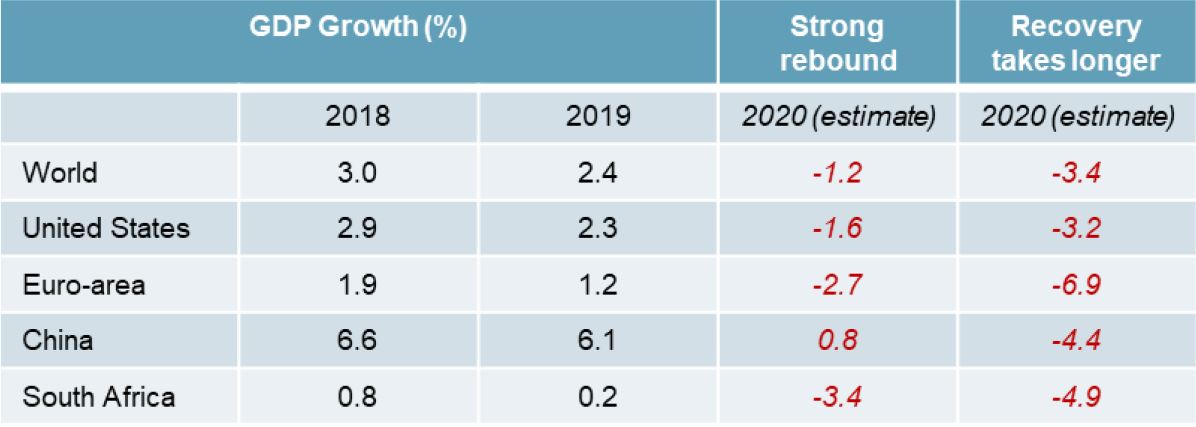
It is extremely difficult to produce a point forecast on the exact slowdown in the global economy. Stanlib’s Economics team calculated that, if the disease is brought under control during the next ten weeks, there’s a good chance we will see a strong rebound during the second half of the year. This could limit the damage to a global GDP contraction of a little over 1% in real terms. If, however, it takes longer before the current severe lockdown measures are relaxed, the global economy could shrink by between 3 and 4% in 2020. During the global financial crisis in 2008/2009 the effect was far less severe, as China still grew by nearly 10%. This helped global GDP to remain flat in real terms during that crisis. This time around they will be unable to make up for the rest of the world, as indicated in the table below:
In the United States, initial jobless claims spiked dramatically, with over 6.4 million new claims being registered in the last two weeks of March. This will have dire consequences for their unemployment rate which was at a 50 year low going into this pandemic. Small and Medium-sized Enterprises will be hit hardest as they typically don’t have the same quality balance sheets compared to large corporates.
The fiscal and monetary stimulus announced by the world’s major economies over the past month has been a global policy event without precedent in peacetime. The Financial Times reports that the increase in fiscal spending and loans in the US this year alone will reach more than 10 per cent of gross domestic product; larger than the rise in the federal deficit through 2008 and 2009. Although this is probably not as big as the financial stimulus implemented by China after the financial crash 12 years ago, most big economies could see government debt to GDP ratios rising by 10-20 percentage points.
The impact of central bank injections will be equally enormous. It would not be surprising if the US Federal Reserve’s balance sheet increased by $2tn-$3tn this year, up from $4.2tn at the end of 2019. The upside is that interest rates may remain low for even longer, however this form of financing can be very risky if inflation starts to rise. As it stands, there is almost no sign of inflation on the horizon, however the potential for rapidly increasing inflation rates has been building since 2008/2009. Like a taught rubber band, the release will be all the more spectacular the further it is pulled out.
In China, authorities have started to gradually lift the lockdown that started in January, however this has not been a smooth process in all instances. In many provinces it has been a phased approach and will likely take months before life is back to normal. It will, however, provide a lot of guidance to other countries as they look forward to reviving their economies beyond the current social distancing measures
South Africa
The South African Reserve Bank’s Monetary Policy Committee’s (MPC) second meeting for 2020 introduced the first of several monetary measures designed to assist the local economy through this crisis. The primary measure promulgated by Governor Lesetja Kganyago was a reduction of
1.00% in the repurchase rate.
In addition, the MPC has stepped in to keep money flowing in the economy by providing lenders with cheaper access to funding and re-organising the way they inject liquidity into the financial system. These measures include the purchase of government bonds on the secondary market which, when effectuated, had an immediate positive effect on government bond yields.
This follows President Cyril Ramphosa’s announcement of a nationwide lockdown of 21 days in order to slow the spread of Covid-19 in South Africa. Three weeks of very little commercial activity outside of essential services will hurt an already encumbered economy, however it does provide health services the opportunity to step up testing and preparation for increased hospitalisation. It’s a tough balance to strike between health and economic risks – both of which will have a significant impact on South African consumers.
A silver lining is that the petrol price fell by almost R2 per liter on the back of a much-reduced oil price, this despite a significantly weaker Rand. When the wheels of the economy start turning again it will produce an essential tailwind for businesses and consumers.
Lastly, the long-anticipated downgrade of South Africa’s sovereign debt rating by Moody’s was announced at the end of the month. As reported before, much of this downgrade has been priced into our bond yields. Nevertheless, the Rand still took a significant beating. The local currency now seems considerably undervalued against the US Dollar, which puts it in the same boat as a whole host of other emerging market currencies